Tuesday, December 25, 2007

Nuclear Energy


I just finished reading a review of Power to Save the World: The Truth About Nuclear Energy which really gives one something to think about re nuclear power and the health of our world. The review was printed in Wired Magazine with the link to the article at the end of this note.

Startling fact: A family of four in France, where nuclear fuel is used, will produce only enough waste to fit in a coffee cup over a whole lifetime. A lifetime of getting all your electricity from coal-fired plants as used in the U.S. will make a single person's share of solid waste (in the United States) 68 tons, which would require six 12-ton railroad cars to haul away. Your individual share of CO2 would be 77 tons.

The only way to rescue our plug-hungry planet from catastrophic global warming is to embrace nuclear power, and fast. That's the argument of Gwyneth Cravens, journalist and former nuke protester.
Her new book, Power to Save the World: The Truth About Nuclear Energy, is a passionate plea to understand, instead of fear, atomic power. In her book, Cravens is guided Dante-like through the entire life cycle of nuclear power -- from mining to production to waste disposal -- by one of the world's foremost experts on risk assessment and nuclear waste. Her conclusion? Every day spent burning coal for power translates into damaged lungs and ecosystem destruction. If the world wants to keep plugging in big-screen TVs and iPods, it needs a steady source of power. Wind and solar can't produce the "base-load" (or everyday) steady supply needed, and the only realistic -- and safe -- alternative is nuclear.

To find out more.

Monday, December 24, 2007

Dance & Burmese Padaung Karen Tribe

When Jim and I were in Bali a few years ago, we watched young girls practicing traditional dances and were amazed at how graceful their hand motions were. I've seen this kind of dance often in Thailand at special events, and I've just learned that in order to achieve this graceful look, the girls' fingers are wrapped with elephant grass at a young age. Their hands are forced to bend backward which creates the unusual and beautiful curve when the hand is unwrapped. The process is incredibly painful and takes many years to achieve a permanent curve.

This is a simlar to what many young women endure in the Burmese Padaung Karen tribe, or Long-Neck Karen. This effect is created by adding multiple rings periodically that elongate their necks by deforming their collarbones and pushing their shoulders down. They have become an object of curiosity for both Asian and Western tourists.

There are a couple of reasons why Karen women originally wore the heavy solid copper rings around their necks. They believe in spirits and believe that the tiger spirit may come in the night and bite their neck without this shield, just as snake spirits will bite their legs without the leg wraps. [See photo of Akha woman.] They also submitted to this "decoration" as it was felt that the longer their necks were, the more beautiful they are considered...Often these young women now are used to bring tourist dollars into the villages. There are some Long-Neck Karen villages along the Thailand border and have been described by many as one of the closest things in Asia to a human zoo.

Disclaimer: I did not take these photos.

Saturday, December 22, 2007

Hitchhiking to Khon Kaen


Jim recently hitched from Chiang Mai in northern Thailand to Khon Kaen in Northeastern Thailand to visit friends Narong, who manages a dairy plant, and Noi, who teaches physics. One reason Jim went there was to attend the graduation of their daugher, Aom, from KK University. Here he is with Aom and her cousin, Eeya, who recently visited us in Chiang Mai.


Narong wrote to me, soon after Jim's arrival: Hi Gail, Jim arrived KK Dec 15 safety. Now he have had well care from me. We have cheer with him with 2-3 Changs a day. I and Jim will cheer for you too. Narong [So I guess we know what they were up to.]


The photo above was taken last year when we visited them in their country home. Here's another photo from last year that Jim took of me and Aom and Eeya at their city home.


Jim's two-day trip was filled with "a slew of mini-adventures." Here's a few of them:

"I am not a role model." An off-duty police officer gave me a NASCAR qualifying trip to Phitsanoluk. He told me to fasten my seat belt as soon as I got in the car, but safety was the last thing on his mind. His car was designed and equipped for speed. We weaved through all traffic ahead of us like in a video game. He delighted in tailgating, then passing with just inches to spare. He wore racing gloves. Ironically, this "officer" had two full cans of Leo beer sitting next to him in plain sight. Even when we stopped at a police checkpoint, he did not hide the beer. While off-duty in his police sruiser, this guy felt no obligation to be a role model.

"Hitching Thai-style: The more, the merrier." The next day I was on the highway hitching when six college-age students filed by me with backpacks and camping gear. They stopped up ahead of me. Someone joined them on a motorcycle. After a few minutes, I realized they were trying to hitch a ride. Never in my travels have I seen 6 people trying to hitch together! They were defying all logic. I was curious, so walked up to them. Older guy with the motor bike greeted me, drunk as a skunk. Ignored him and asked the students about taking their picture. They were real cute doing a group wave to attract a ride. It was like being at a ballpark. There we were, three young guys, three young gals, one old drunk, and me trying to wave down a ride.

Within minutes a truck stopped. The students squeezed into the back with their gear. There were several trays of eggs in the back as well. My gregarious Thai pals motioned me to join them. Being the old guy in the group, I was given a seat in the cab. The drunk sadly waved good bye. The driver cruised along about 50 MPH. Some of the crew sat up on the side rails, which made me very nervous. Hit one deep pothole and they would be history.

Eventually we were dropped off and started waving for another ride. They invited me to go camping with them. They were headed to a national park in the mountains. Thought I might do it, but a truck stopped with only enough room for the 6 of them. They wanted to make room for me, but it would have been very cramped. So, I declined to join them and wished them "choke dee"(good luck.) This experience helps show that magical thinking can work, especially in Thailand.
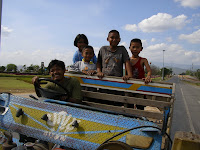
"Any ride is a good ride." Further down the highway, I spotted an old Thai farm tractor chugging along towards me. There were a bunch of children in the back. I waved as they went by and the driver stopped. I was in no hurry, so jumped onboard. It was a first for me. After a mile or two, we stopped at a major intersection. I jumped off, snapped a picture, and thanked them.
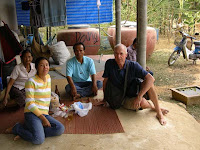
"Don't hitch and drink." It was early afternoon when I got another ride. This person was very jolly and wanted me to buy some beer and perhaps stay in his home that night. It was early for me but said OK. Bought a couple bottles of Beer Chaang. Before I could open a bottle for him, he shoved it in his mouth and removed the cap with his teeth! Within a few minutes, we were at his home, which was near the entrance to a national park, probably the park where my young hiking mates were headed.

We sat on floor mats in front area of the home. There were some chickens running loose in the yard. Various members of the family showed up and had some of the beer. Then the guy suggested I buy three more big bottles. Apparently, they were ready to settle into a major session and I would be funding it. The first five beers would only be the tip of the iceberg. In a couple of hours, word would be out and the whole village would be at the house drinking themselves silly. Politely made it clear that I had to be moving on. Then picked up my pack and walked out to the highway to continue my journey.

"Hitchhiking is a cumulative experience, a never-ending happening of unknown factors which contribute, with a little luck, to a memory of what real traveling is all about -- not just the chance to say that you've been to a place, but the feeling that one time, somewhere, even if only for an instant, you felt like you had become a part of the land through which you were traveling." -- Ken Welsh

Wednesday, December 19, 2007

Give the Gift of Sight


One day last month in Ubon Ratchathani province in NE Thailand 3,405 people received free eye exams and glasses if they needed them, thanks to an organization called Give the Gift of Sight. "Slow day," one of the volunteers said. Farmers, monks, and villagers come from miles around to get their eyes examined.

This humanitarian mission has just wrapped up and the group is hoping to have given away all of the 65,000 recycled glasses that a family of eye glass specialists brought from Italy. [Last February 26,282 people in the Chiang Mai area were also seen.] Give the Gift of Sight is also handing out heaps of sun glasses as well to stop the sun damage they're seeing.


This week, I waited with a friend for several hours at Chiang Mai Ram Hospital. The large waiting area was centered in a large atrium with all the medical specialty offices radiating out from that with lots of glass and few doors - great opportunity to get an overview of all that was going on. Many of the Thai nurses were wearing very attractive form-fitting white uniforms and heels; they looked very sharp, efficient and. . . lovely. This was the kind of nurse image little girls used to daydream about back in the 50s (and men probably still do.) [Photo of nearby Chedi on my bike route.]


Perhaps the time is coming when I shall have to move on and explore somewhere else, somewhere not quite so comfortable and seductive with all it has to offer. I just read in Chiang Mai News, "Last week I realized I had managed to reach the stage where it was possible to take the whole day just to make a cup of tea." [I'm not quite that bad yet, but what an simple life this is.] The trouble is that I enjoy being here so much that it's hard to break free. But so much more to explore - here and elsewhere. I still haven't decided how much adventure I want in my life and how much I want to stay put, relatively speaking, and become part of a community. [Photo of another one of my favorite shops.]

Yesterday, I was standing outside Kun Dtuum's home taking photos of her hanging orchids. Her husband drove up and took my camera so he could take a photo of the two of us in front of their home.


"Some journeys take us away from it all, to places no one knows us; some take us to where it seems we've always been. And whether we venture to a new part our country or into an entirely new culture, travel forever changes the boundaries of the world we once knew."

Sunday, December 16, 2007

Three Good Books


Here are three more books that I have read and heartily recommend.

Do They Hear You When you Cry by Fauziya Kassindja - a memoir of a 16-yr old woman who fled her home in Togo, a small country in Africa, in the mid-90s as she was yanked out of high school and forced into marriage. Her husband was 30 years her senior and already had three wives. On the day of her marriage, she was about to undergo her tribe's ritual genital mutilation. She escaped to the U.S. and most of the book describes her cruel and inhumane experiences in various U.S. detention facilities for immigrants seeking asylum.

First They Killed My Father - A Daughter of Cambodia Remembers by Loung Ung, a childhood survivor of Pol Pot's regime has written "a riveting narrative of war, desperate actions and the unnerving strength of a child and a family." Because of the starvation and deprivation, the women of Cambodia in the 1970s were so underfed, overworked, and filled with fear that must could not become pregnant and if they did, many suffered miscarriages. In Cambodia today there is a generation of children completely missing. I learned that the reason there are fewer disabled people in Cambodia [from loss of limbs from mines] is because the Khmer Rouge simply killed any people who survived the accidental mine detonations.

red CHINA blues: My Long March from Mao to Now by Jan Wong - the memoir of a Canadian born ethnic Chinese who, so disaffected with the government and policies and culture of North American, she embraced Maoism and lived in China for many years, as a student and later, as a reporter. She gradually became thoroughly disillusioned with China's government and policies. A witty and very personal strong voice.
Note: one individual she wrote about named all of his six children Fu Min, using different ideograms for min, comparable to naming your six kids leslee, lesley, leslie, lezlee, lezley, lezlie. [Joyce - thought you would enjoy this.]

As a student she was assigned to write for a chapter for a book on Chinese history. She chose the Taiping Rebellion, which I had heard of but knew little about. There was a massive peasant uprising with neo-Christian roots that lasted from 1851 to 1864 and resulted in 20 million deaths.

The following took place at a workfarm in which she insisted on particapating when she was a foreign student. "At night, we poured half a bottle of pesticide into a washbasin, diluted it with water, and sprinkled it with our bare hands over the floors and walls until our room reeked. I watched the mosquitoes die in mid-flight and tried not to think what it [might be] doing to my descendants."

I’m convinced that to maintain one’s self on this earth is not a hardship, but a pastime, if we will live simply and wisely. – Thoreau

Saturday, December 15, 2007

Thai Translations


Mist? Fog?
The more vocabulary I learn in Thai, the more I understand how most of their multisyllabic words are made from joining together two or three simple words. For example, one of the words for "mist" or "fog" is called "shy rain." [This photo was taken on the Thai Burma border.]


ข อ โ ท ษ ข า is khòór thôht kaa, equivalent to "excuse me," used if bumping into someone or when trying to get someone's attention. But with a slight difference: "Please excuse me" in English translates into Thai to mean "Please punish me!"
[This is the AUA Language Center.]

Some Thai proverbs translate perfectly into English. Others are a bit oddly interpreted. My favorite is "To know things in the same way a duck does" which apparently is translated in English to be the equivalent of "Jack of all trades, master of none."

Don't catch fish with both hands = You can't have your cake and eat it, too.
Playing the violin for water buffalo = Casting pearls before swine.
Bad seven times, good seven times = Every cloud has a silver lining.
Out of the frying pan and into the fire =
Out of the tiger's mouth into the alligator's.
Splitting hard wood with an axe = Calling a spade a spade.
Buddhist holy days don't occur only once = Every dog has his day.

"This was the moment I longed for every day. Settling at a heavy inn table, thawing and tingling, with wine, bread, and cheese handy and my papers, books and diary all laid out; writing up the day's doings, hunting for words in the dictionary, struggling with verses, or merely subsiding in a vacuous and contented trance while snow thawed off my boots." Patrick Leigh Fermor

Friday, December 14, 2007

Examining your life...


Jon Katz writes about change in Running to the Mountain - A Midlife Adventure. "There is a huge risk involved in examining your life. You may find that you’re not all happy with the life you are living, that you’re unfilled. Before, you might have been content to stumble along, to accept the reality of your life. But now – to change or not? Will you regret it? . . . . Self-awareness, introspection, searches for the meaning of things – all these are hard, painful undertakings. And there’s a huge risk involved whenever you seek to discover what’s inside you, what you’re made of. . . . We’re taught to be frightened of change. What if I love what I have and don't want to explore? What if I try and fail? The drama of it all is that when all is said and done there’s a choice – get help when needed, take risks if necessary, make changes when appropriate. In my experience, the people who do these things have more often found happiness than the people who haven’t. . . . The choice of risk versus caution looms in front of us. Happiness is the hope for much of what we do. If we have that, stasis is fine. If we don’t, change and risk are sometimes the only choice. . . . I shouldn’t overlook one of life’s most basic tasks – to have a good time."


To be sure that your friend is your friend, you must go with him on a journey, travel with him day and night, go with him near and far. -- Angolan proverb